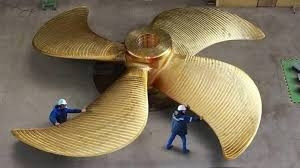

Diameter.......
I have been getting a lot of inquiries lately from people wanting a larger diameter prop.....not sure why this is suddenly a thing, but it appears it is...
Diameter is one of things on an outboard/sterndrive prop that is extremely important, but isn't something that is used to fine tune a motors performance the same way that pitch, shape and blade count is.....why is that?
The diameter on an outboard prop is governed by three main things.....gear ratio, hub size and gearcase size.
Gear ratio:
Gear ratio is the amount of turns of the crankshaft in relation to how many turns the prop shaft makes. The main reason outboards and stern drives don't run a 1:1 ratio is because of packaging....its hard to make the gears in the gearcase small and strong and maintain the desired size....most outboards run in the 1.5:1 to 1.9:1 area. But outboard and stern drive manufacturers choose different ratios for their outboards to suit the characteristics of the motor design.....for instance, Suzuki run a shorter stroke, bigger diameter bore design than Yamaha, which typically have a longer stroke, smaller bore design. The Suzuki design results in a shorter powerhead, but they need a gear ratio that allows higher RPM to better utilise the torque of their motors, which occurs higher in the rev range than a similar sized Yamaha. As a result, many Suzuki models use more pitch and a bigger diameter than a Yamaha, Mercury or Honda outboard. Some outboards also have an offset gear set under the powerhead, which also changes the type of prop required.
Hub size:
Imagine you have a motor that has a 75mm gearcase. That size gearcase will normally have a 230-250mm prop diameter....now, why couldn't you just have a 75mm hub, with a 300mm or 350mm diameter?....wouldn't more just be better?...well, no....for two reasons.....the smaller hub doesnt have the surface area, or room to support a bigger diameter blade. For an optimised prop design, the blade gets wider at the base as it gets taller....a tall, very narrow blade on a small hub just doesn't work.....a tall, narrow blade is much weaker and is prone to flex and break near the hub.....making the blade thicker fixes this, but a thick blade is very inefficient.....you chew a lot more fuel....Large ships have a much bigger blade to hub size than an outboard, but their props spin very slowly in comparison.....200-300rpm to 3500rpm.....
Gearcase size:
The other reason is clearance on the gearcase.....outboard manufacturers know that tall, narrow blades don't work real good, so they design their gear case to accept the optimum sized blade to suit the hub size of the motor. The hub size is based on the power and torque that motor produces.....a 3" hub size on a 300hp outboard will work, just not for very long.....you can get away with it on a race motor that doesn't do a lot of hours, but for the rest of us, we need more durability....
The other things that are also important to remember when talking prop diameter is surface area and also the pitch....
Surface area:
The more you increase the blade diameter, the more surface area the blade has. More surface area means more material in the water and more bite......a bigger blade grabs more water......but a bigger blade with more surface area also increases drag.....the more drag, the more horsepower is used to spin the prop.....a high surface area prop is great for getting a boat up and moving, but its not so good for your fuel economy when cruising or you are flying out to your fishing spot of a calm day.....you can decrease the surface area of a large diameter prop buy making the blade thinner, but if the gear ratio and characteristics of your motor don't suit a thinner blade, it wont work.
Pitch:
Pitch is the effective angle of the blade and is a measurement of how far forward the prop will travel in one revolution in the water. a 15" pitch prop will go 15" forward if spun in static water. As pitch increases, the blades of an outboard propeller become more laid back, or raked. As the blade is further laid back, the diameter naturally decreases. That's why a 19P prop will have a smaller diameter than a 15P prop for the same series motor......if the prop manufacturer increased the blade diameter along with the pitch, they the blade would have a lot more surface area, which would drastically change the performance of that prop design.
So, in summary, diameter is very important for fitment reasons and prop design overall, but its not the way props are selected when fitted to and outboard or a sterndrive.....shape, blade count and pitch are the criteria that are used, diameter just comes along for the ride.....large propeller companies like Solas do a lot of R&D on what props work on what motors.....sure, there is a lot of crossover between brands, but if you look closely, a lot of the props listed have pitch ranges and diameters that are different to what is used on other brands.....Solas tailors the prop shape and pitch around the diameter that the outboard manufactures allow room for on their gearcases.....
So always select a prop that is recommended for your outboard and select the shape, blade count and pitch to suit your usage.....don't worry about the diameter, Solas have that sorted ;)
Propeller diameter
13th Mar 2026